

BillQuach

About

~ $ whoami

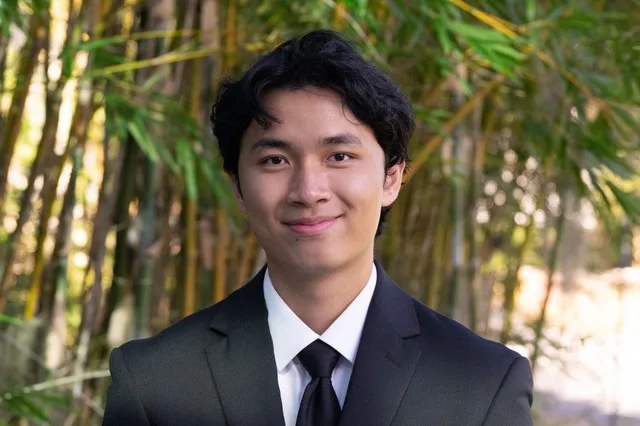
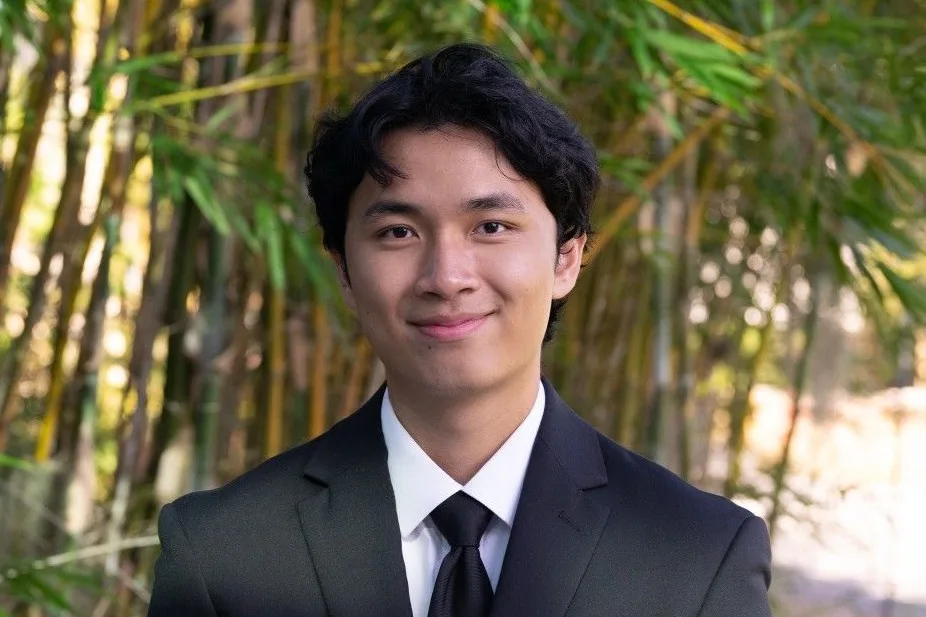
Hey, I’m Bill!

I’m a computer science student at UCF who learns best by building: recently, I've picked up CUDA for my research, embedded for a hackathon, and WebGL for this website, with much more to come!

I moved to the U.S. at five without knowing any English, and I picked most of it up from Minecraft redstone tutorials. Redstone is the game’s wiring: signals, switches and logic gates you can build into working machines, and my first personal project was an automatic shop that took your items, counted them and paid out what you bought. My dad noticed, and when I was nine he bought me an intro to Python book (I didn’t finish it, but it stuck). By thirteen I was taking apart old PCs and building my own.

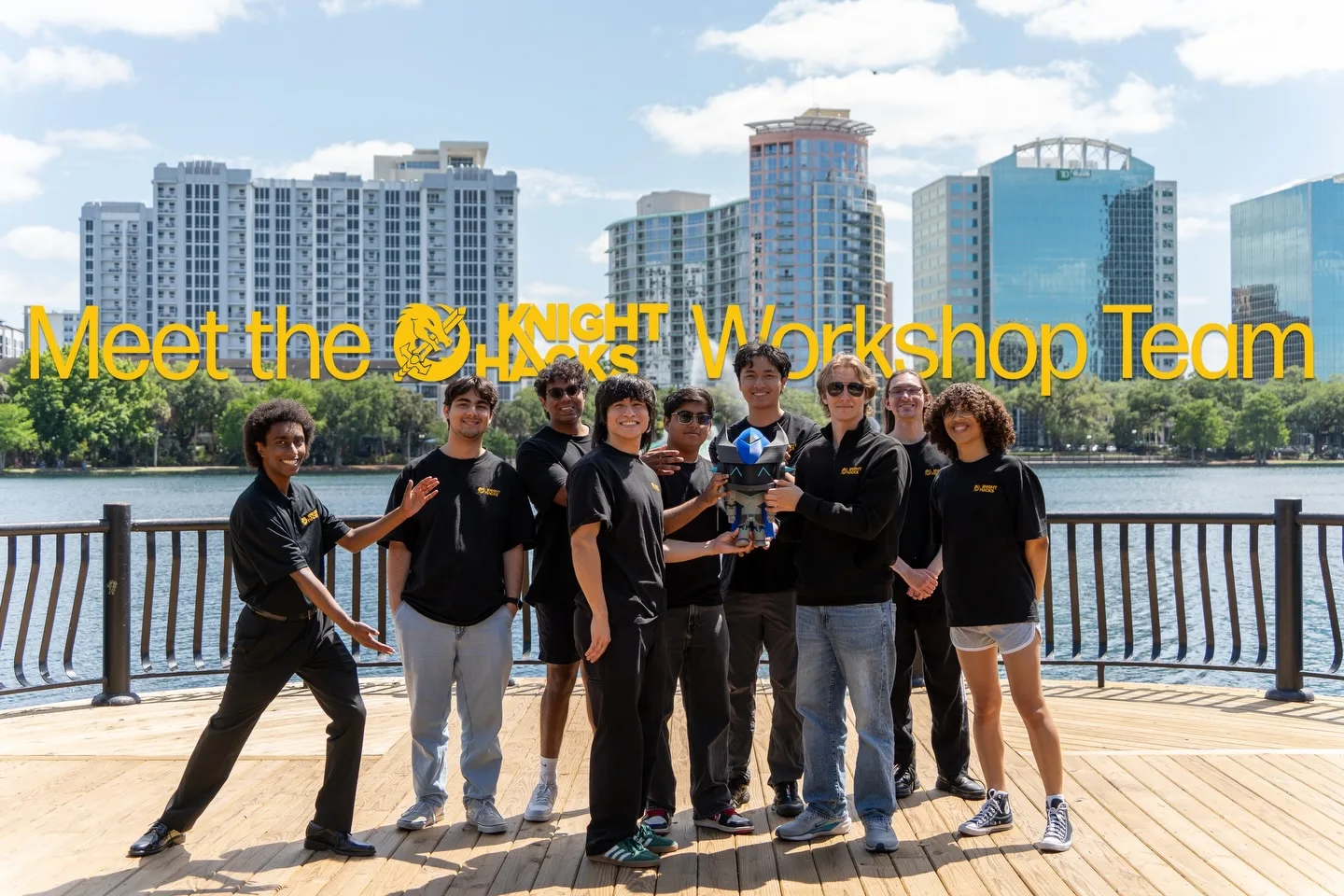
Community is one of the many reasons why I love computer science. At Knight Hacks, UCF’s hackathon club, it feels like one big friend group where everyone helps each other out; I'm proud to represent this community as a quality assurance engineer on the workshop team to help make sure the code behind our technical workshops actually runs, so our 300+ attendees get to spend their time building instead of debugging. I’m also an undergraduate researcher at UCF, where I work on LLM inference on memory-limited hardware with vLLM.

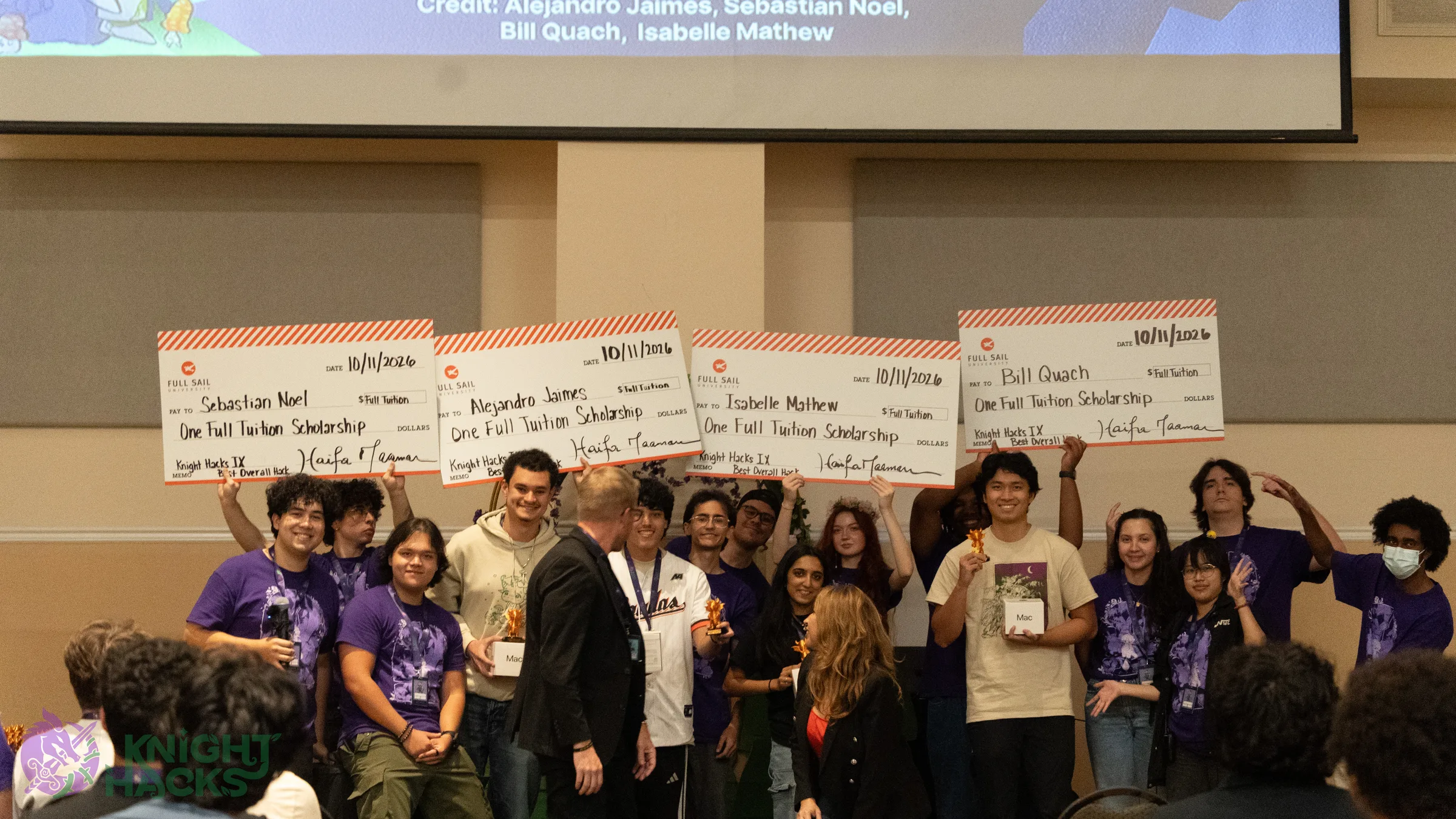
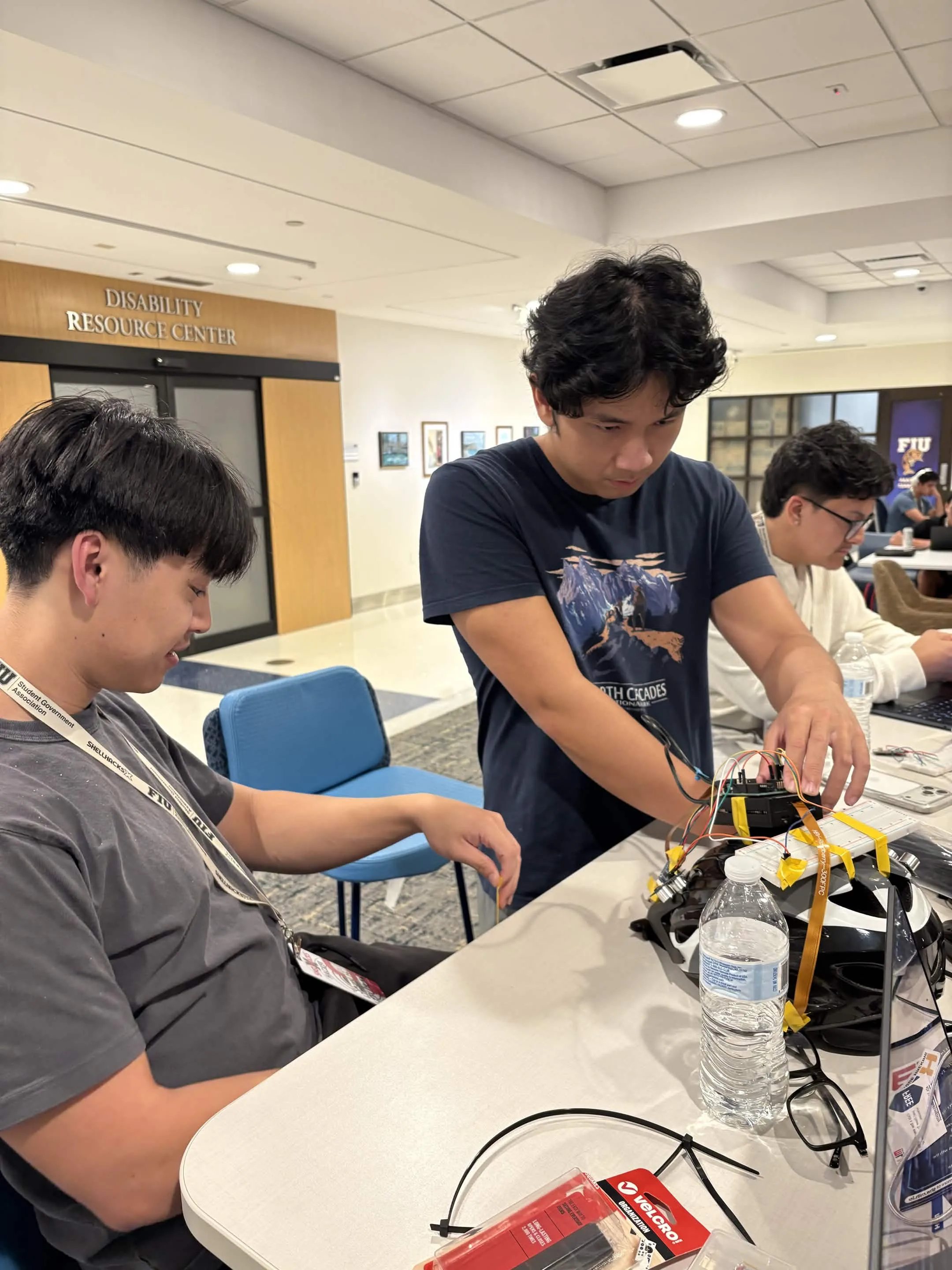
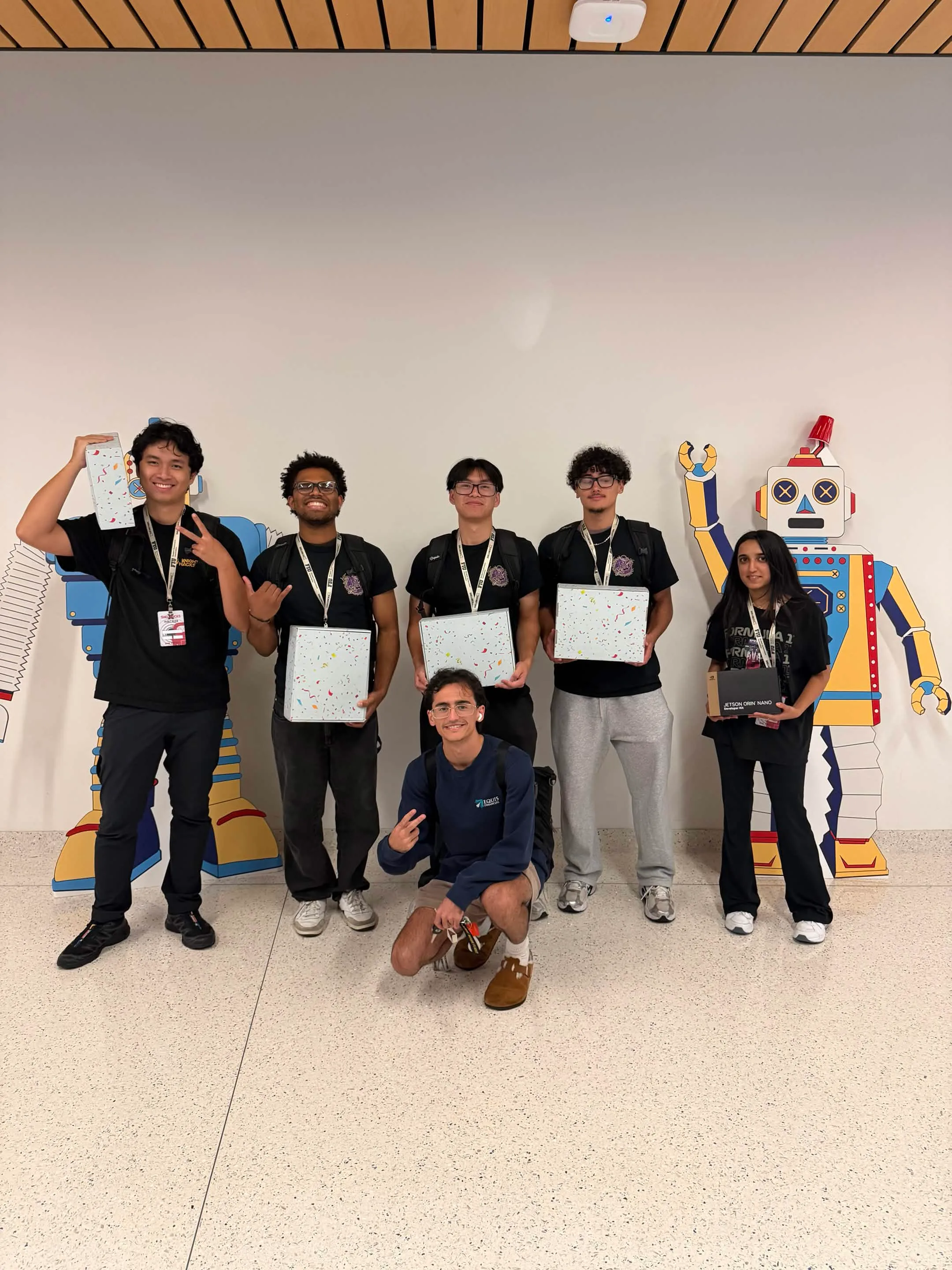
My latest project is Permanence, a memory for robots that keeps track of objects even after they’re hidden, and it took 1st overall at Knight Hacks IX! Check it out → Another project I’m proud of is Halo, a bike helmet that watches a cyclist’s blind spots.

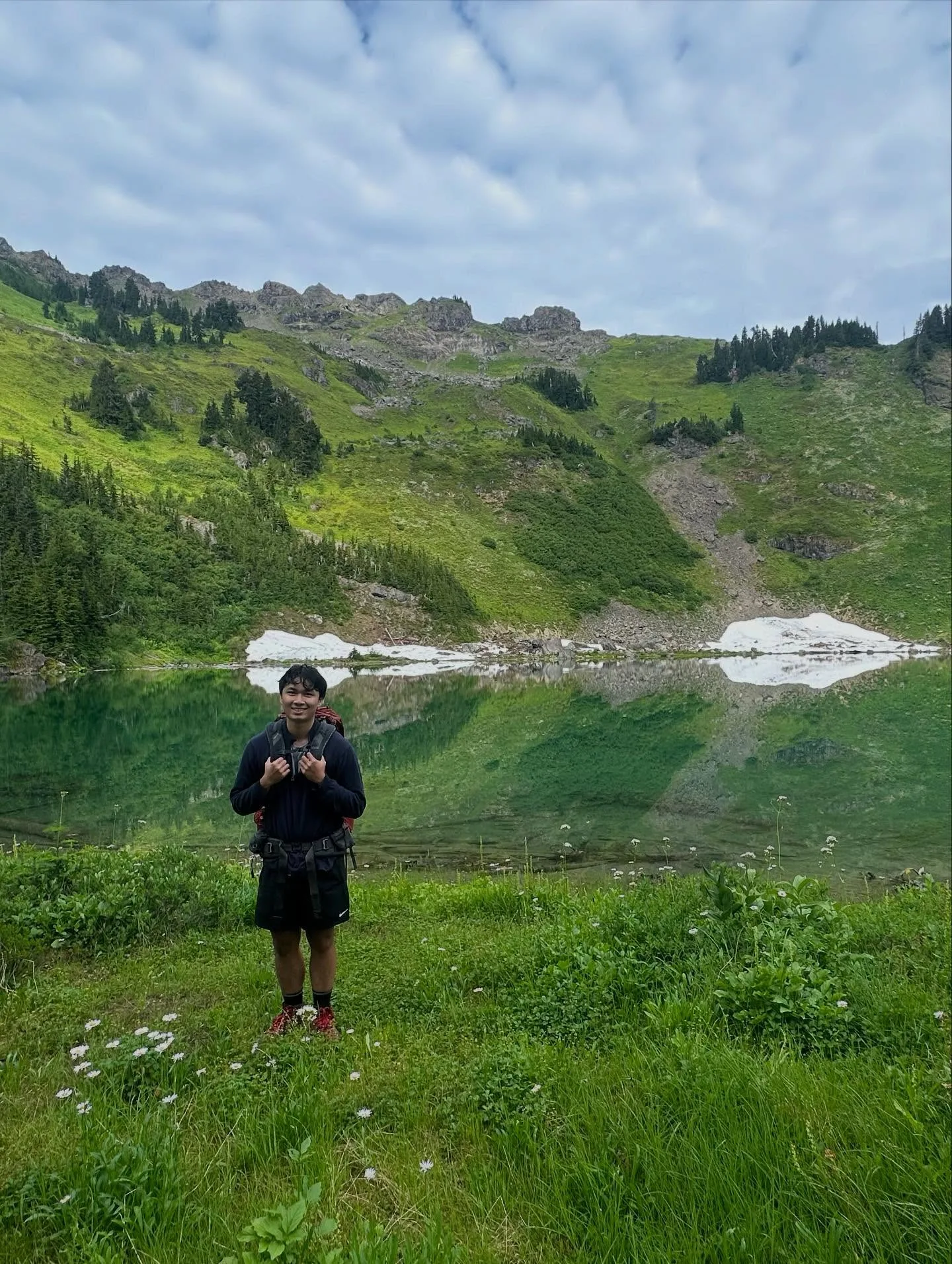
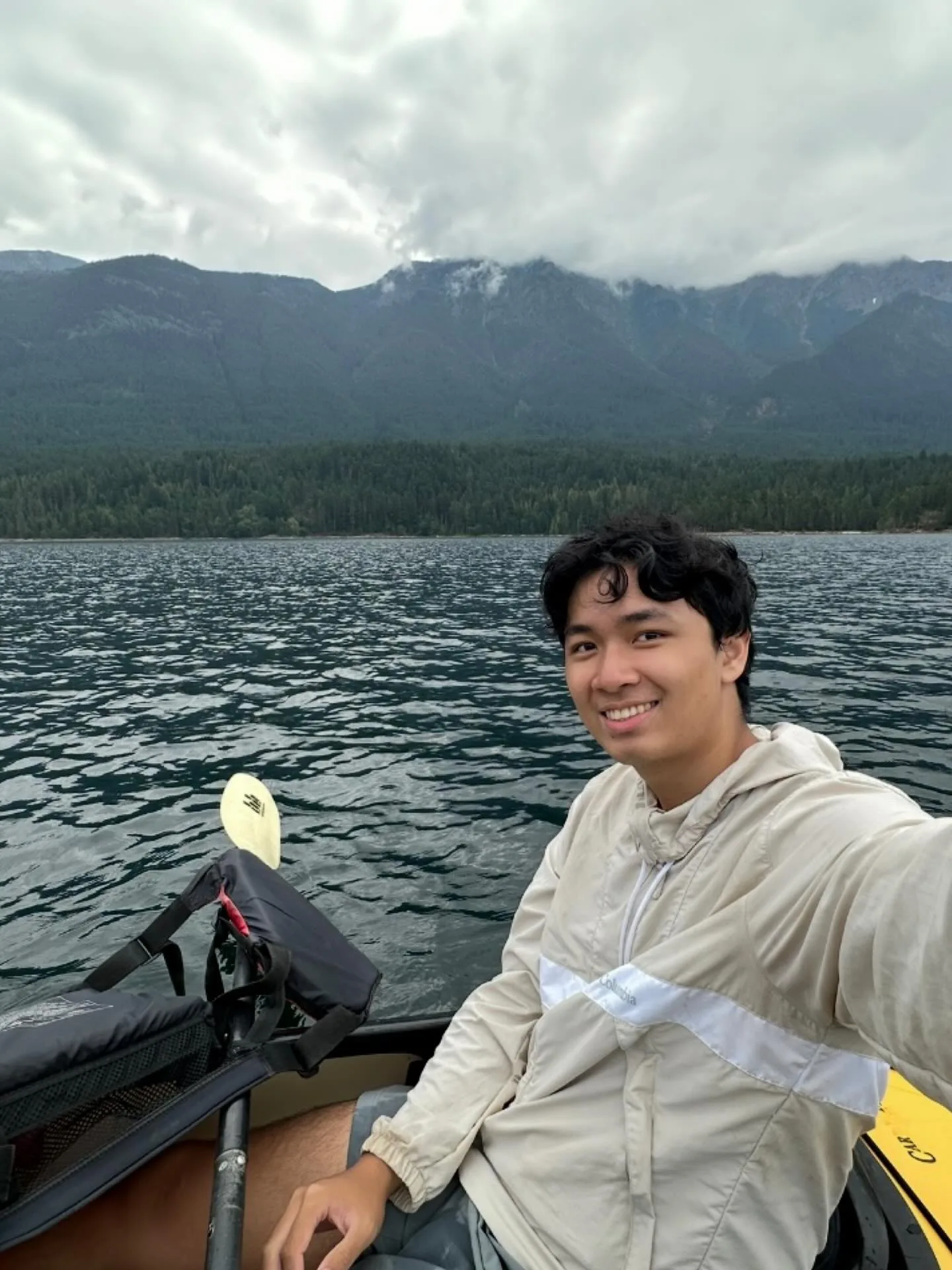
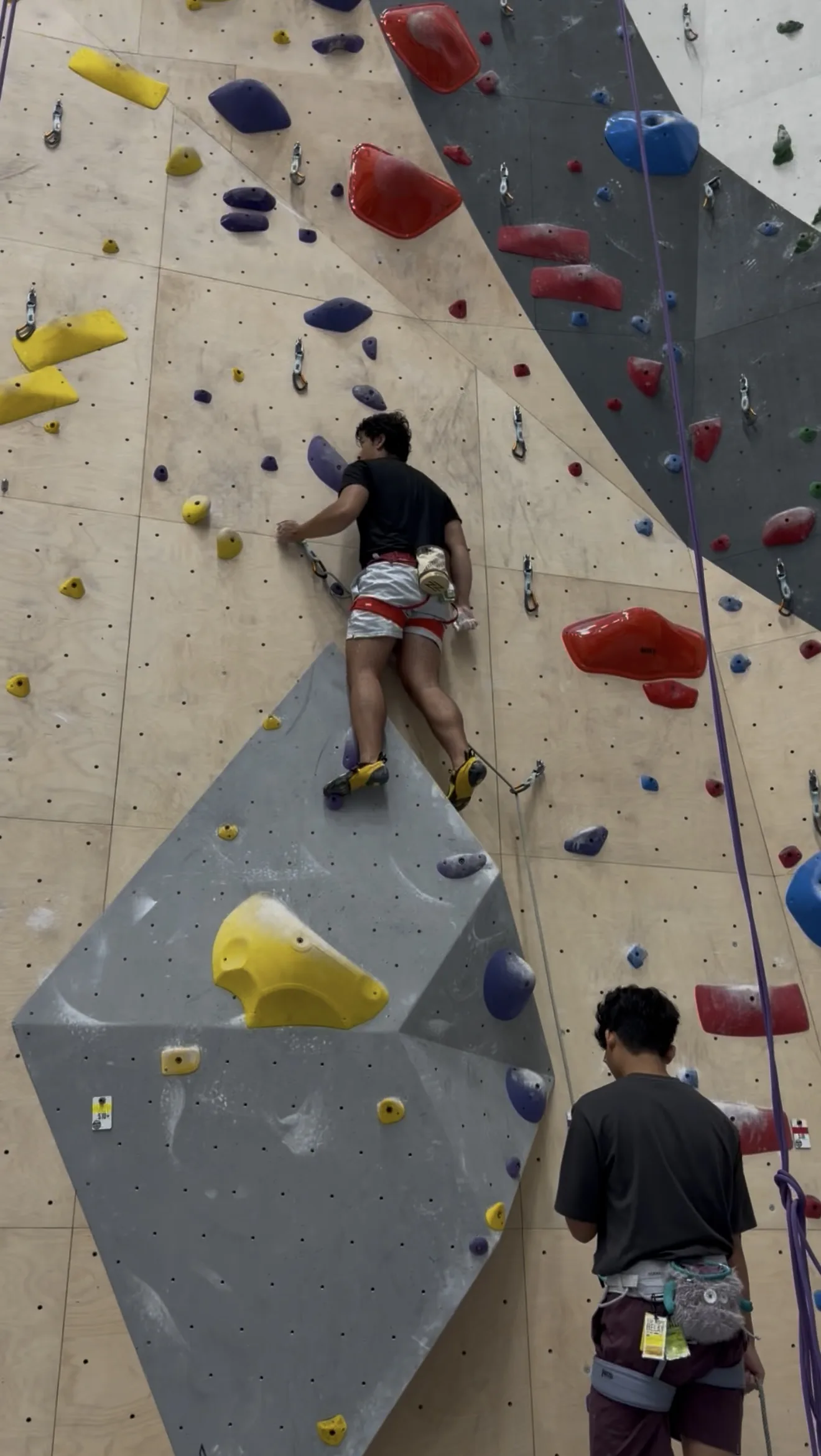
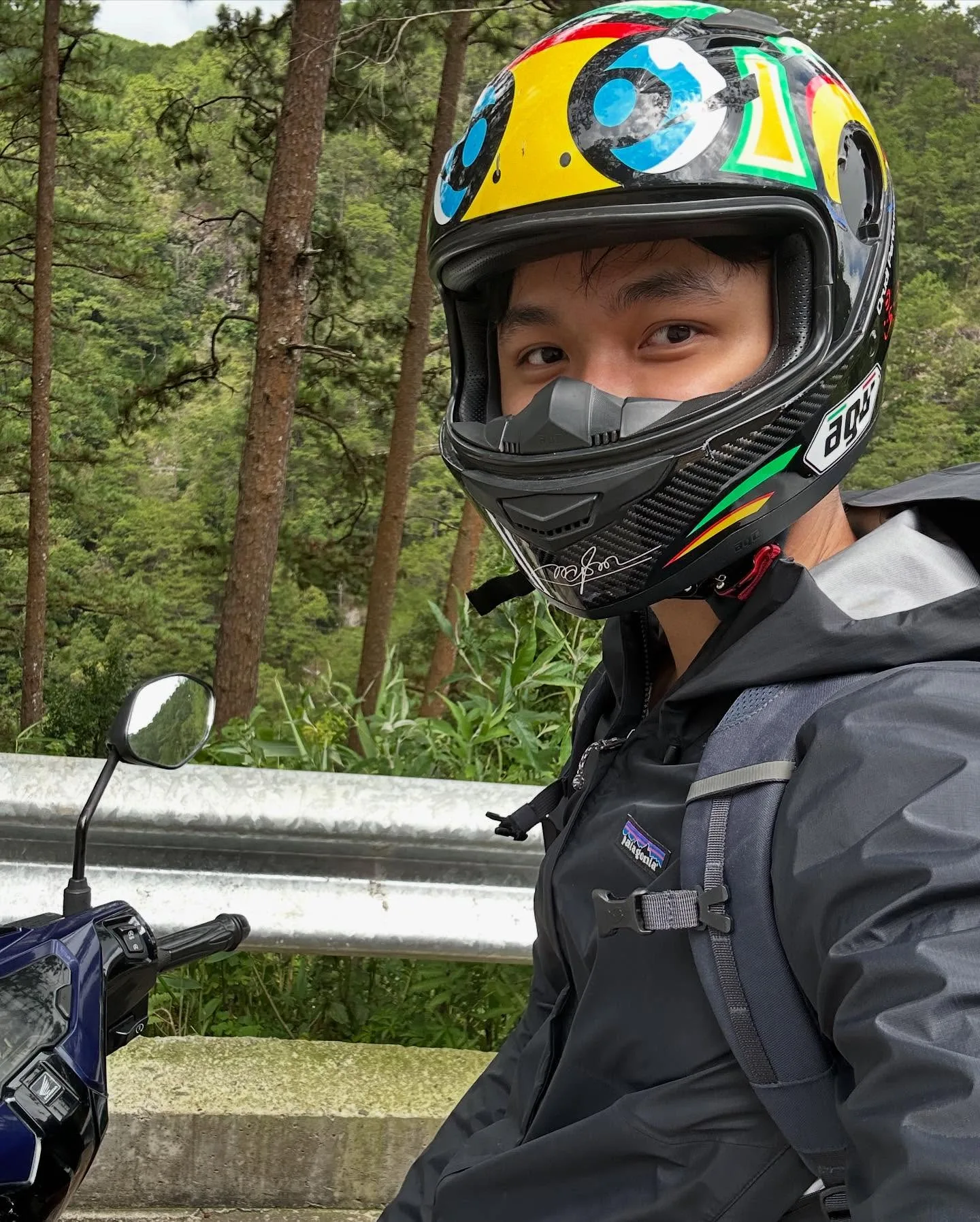
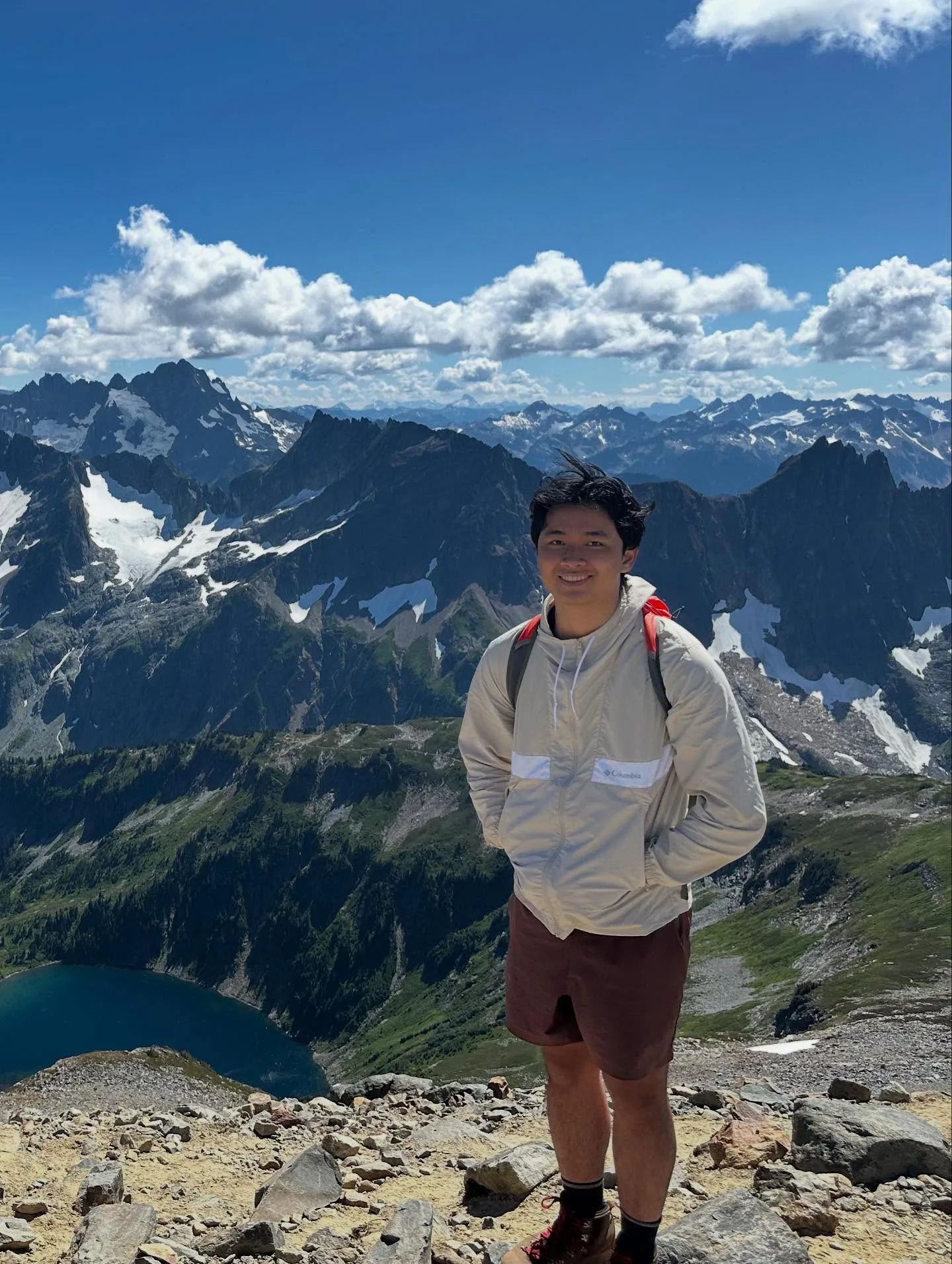
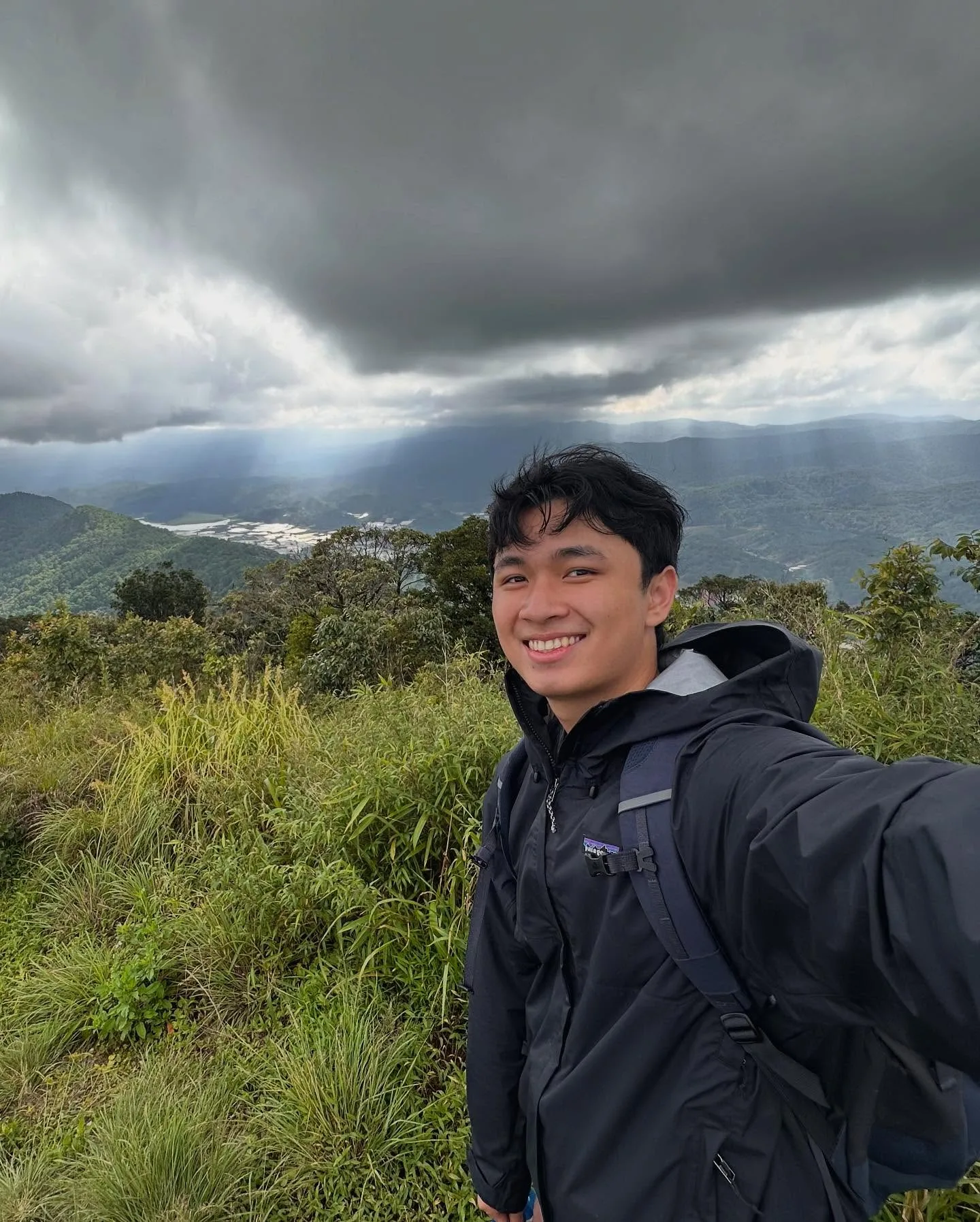
When I’m not coding, you’ll find me , , or off somewhere new.

~ $ cat now.txt

now
Undergraduate Researcher, LLM inference with vLLM
also
QA Engineer, Knight Hacks
focus
ML systems, computer vision, full-stack
open to
SWE internships

~ $ ls skills/ | head

Python C++ TypeScript PyTorch CUDA vLLM OpenCV React FastAPI Linux +32 more on the tree's roots ↑

~ $

Bill Quach
Bill Quach, permanenceWin.jpg
Bill Quach, alpine-lake.jpg
Claude Monet, Woman with a Parasol, 1875. National Gallery of Art (CC0)

Experience

~/experience $ cat undergrad-researcher.md

Undergraduate Researcher

College of Engineering and Computer Science, UCF

Aug 2026 – Present

Orlando, FL

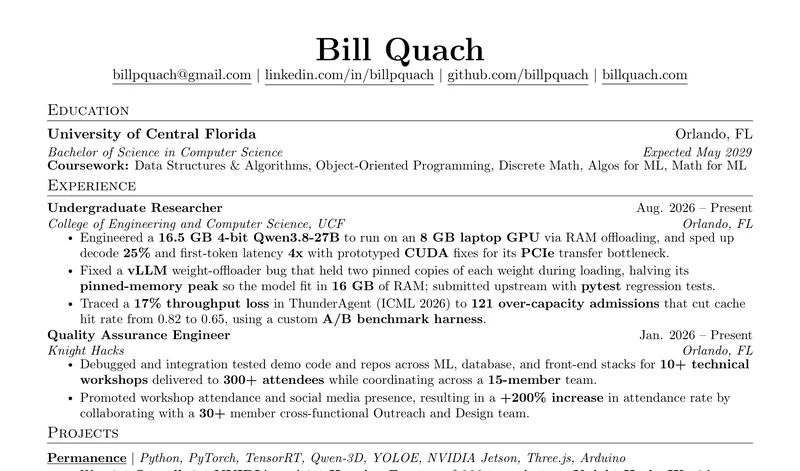
I work on LLM inference with vLLM, on hardware too small for the model. I ran a 4-bit 27B model, twice my laptop GPU’s 8 GB, by offloading its weights to system RAM, then profiled vLLM to find the bottleneck: 98% of GPU time went to matrix multiplies waiting on weights over PCIe. Fixes I prototyped sped up decode 25% and first-token latency 4x, and a loading bug I found along the way is now a pull request to vLLM, under review. Earlier in the role, my A/B benchmark harness measured 38.4% higher throughput from vLLM’s prefix caching.

Key Responsibilities & Achievements

  • Engineered a 16.5 GB 4-bit Qwen3.8-27B to run on an 8 GB laptop GPU via RAM offloading, and sped up decode 25% and first-token latency 4x with prototyped CUDA fixes for its PCIe transfer bottleneck.
  • Fixed a vLLM weight-offloader bug that held two pinned copies of each weight during loading, halving its pinned-memory peak so the model fit in 16 GB of RAM; submitted upstream with pytest regression tests.
  • Traced a 17% throughput loss in ThunderAgent (ICML 2026) to 121 over-capacity admissions that cut cache hit rate from 0.82 to 0.65, using a custom A/B benchmark harness.

$ ls undergrad-researcher/skills

  • vLLM
  • PyTorch
  • PyTorch Profiler
  • CUDA
  • Python
  • Linux
  • Bash
  • pytest

Links & Resources

show more details

~/experience $ cat qa-engineer.md

Quality Assurance Engineer

Knight Hacks

Jan 2026 – Present

Orlando, FL

I debug and integration-test the demo code behind Knight Hacks workshops, across ML, database and front-end stacks, so 300+ attendees get code that runs. I work with a 15-member team on the workshops and with the Outreach and Design team on getting people in the room.

Key Responsibilities & Achievements

  • Debugged and integration tested demo code and repos across ML, database, and front-end stacks for 10+ technical workshops delivered to 300+ attendees while coordinating across a 15-member team.
  • Promoted workshop attendance and social media presence, resulting in a +200% increase in attendance rate by collaborating with a 30+ member cross-functional Outreach and Design team.

$ ls qa-engineer/skills

  • Integration testing
  • Debugging
  • Machine learning
  • Databases
  • Front-end
  • Teamwork
  • Outreach

show more details

~/experience $ cat ucf-cs.md

B.S. Computer Science

University of Central Florida

Orlando, FL

Computer Science at the University of Central Florida.

Honors & Awards

  • Florida Bright Futures Scholarship, covering 100% of tuition
  • Dean’s List, 2026, with a $1,000 award

$ ls ucf-cs/coursework

  • Data Structures & Algorithms I & II
  • Object-Oriented Programming
  • Discrete Structures
  • Linear Algebra
  • Calculus II & III
  • Algos for ML
  • Math for ML
  • Probability & Statistics

show more details

Claude Monet, The Japanese Footbridge, 1899

Projects

~/projects $ cat permanence/README.md

1st
Overallof 200+ projects
1st
NVIDIAJetson track
1st
Hugging Facecomputer vision and VLMs

Permanence

An object-permanence memory for robots that won 1st overall at Knight Hacks IX.

$ ls permanence/stack

  • Python
  • PyTorch
  • TensorRT
  • Qwen-3D
  • YOLOE
  • NVIDIA Jetson Orin Nano
  • iPhone LiDAR
  • Three.js
  • Arduino

show more details

~/projects $ cat halo/README.md

1st
Waymo challengeof 77 projects
1st
State Farm challengeof 34 projects
<50 ms
vehicle detection on a Raspberry Pi 5

Halo

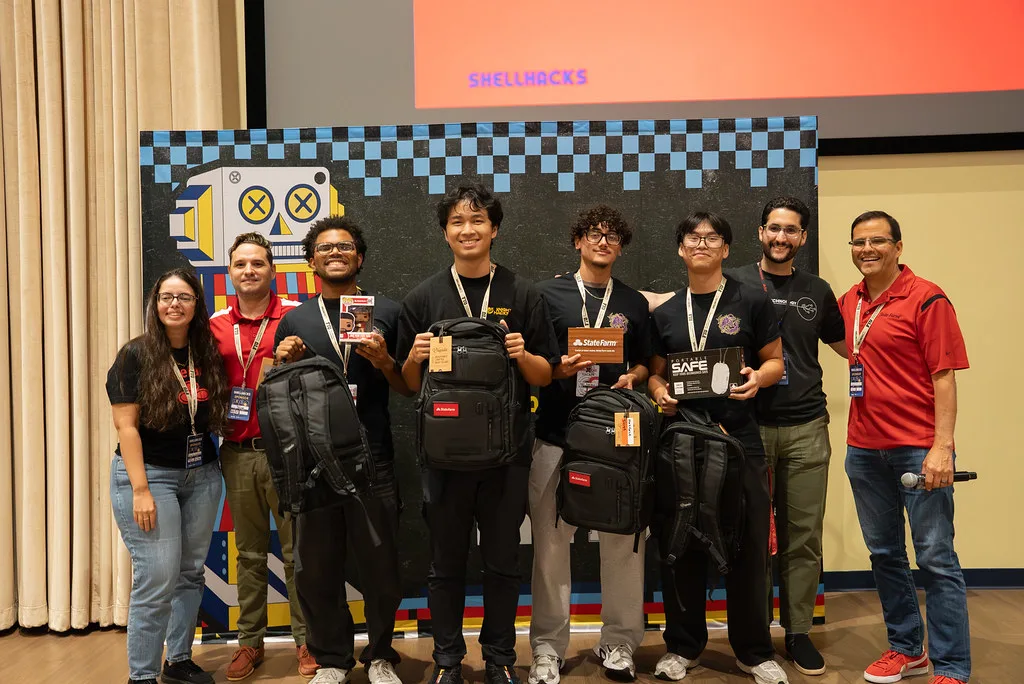
A blind-spot detection bike helmet that won two tracks at ShellHacks 2026.

$ ls halo/stack

  • Python
  • YOLO
  • NCNN
  • OpenCV
  • Raspberry Pi 5
  • Arduino
  • Ultrasonic sensors
  • Three.js
  • Server-Sent Events
  • Gemini API

show more details

~/projects $ cat pinlist/README.md

140+
images classified per call
20+
aesthetic mood labels
≥80%
similarity for top songs

Pinlist

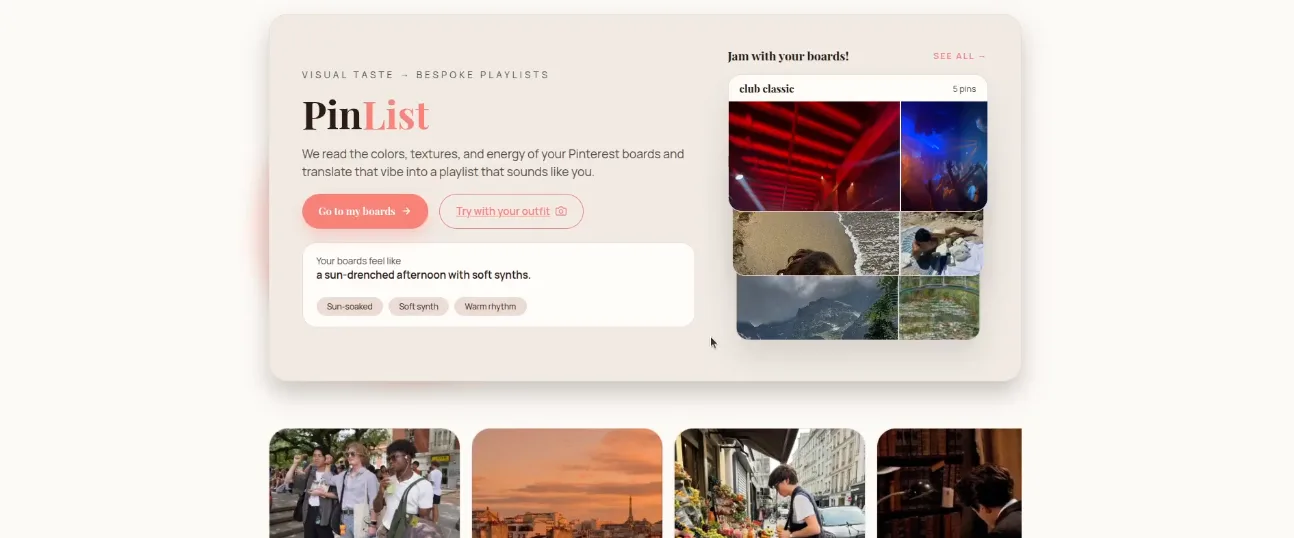
Turns the aesthetic of a Pinterest board into a Spotify playlist.

$ ls pinlist/stack

  • Python
  • CLIP
  • PyTorch
  • Hugging Face Transformers
  • Pillow
  • Flask
  • SQLite
  • OAuth 2.0
  • Pinterest API
  • Spotify API
  • JavaScript
  • HTML/CSS

show more details

~/projects $ cat pagesense/README.md

7,000
titles searchable by meaning
7
emotion dimensions per title
≥25
word floor for clean descriptions

PageSense

Semantic book recommendations over 7,000 titles.

$ ls pagesense/stack

  • Python
  • Hugging Face Transformers
  • LangChain
  • ChromaDB
  • OpenAI Embeddings
  • Pandas

show more details

Claude Monet, Water Lilies

Contact

CS undergrad at UCF, building full-stack software and applied ML.

Open to SWE internships Orlando, FL

billpquach@gmail.com
© 2026 Bill Quach Claude Monet, Impression, Sunrise, 1872
~/projects/permanence

~/projects $ cat permanence/README.md

1st
Overallof 200+ projects
1st
NVIDIAJetson track
1st
Hugging Facecomputer vision and VLMs
96%
hidden objects found in live and recorded trials

Permanence

An object-permanence memory for robots that won 1st overall at Knight Hacks IX.

Permanence won 1st place overall at Knight Hacks IX, out of 200+ projects and about 1,100 participants, along with 1st place in both the NVIDIA and Hugging Face tracks. It gives robots something a one-year-old already has: object permanence. Most robot AI acts on whatever its camera sees right now, so when a cup covers a ball, the ball is simply gone. Permanence keeps a persistent 3D world state of every object, even hidden, covered or carried inside a container, and runs entirely on an NVIDIA Jetson Orin Nano.

Ask the rover for “the cup on top of the box,” and Qwen-3D, a 3B-parameter 3D vision-language model, picks out that object in a point cloud built from an iPhone’s LiDAR. To fit it on an 8 GB board, I ported it to plain PyTorch and wrote its 8-bit quantization with streaming weight loads, cutting it from 7.1 GB to 5.2 GB. It then hands off to a YOLOE TensorRT engine that tracks every object at camera rate, and a 3D world state explains each missing detection: out of view, blocked by something nearer, or inside a container, so a ball under a cup moves with that cup. Loading one model at a time keeps both within 6.4 of the board’s 7.4 GB of usable memory. From there the rover drives to targets no camera can see, while a Three.js dashboard’s x-ray view shows what’s hidden. I led the AI and perception pipeline, its deployment on the Jetson, and our pitch.

In our shell-game demo, the rover commits to which cup hides the ball before anyone lifts it, and it found the hidden object in 96% of live and recorded trials. Its rules for permanence are hand-written for now; next, we’d like a learned world model to predict what moves while unseen, and to send each object’s digital twin into simulation for thousands of shuffles.

$ cat permanence/HIGHLIGHTS

  • 3D language grounding with Qwen-3D, a 3B-parameter vision-language model: “the cup on top of the box” picks one object out of the point cloud
  • An 8 GB fit through our own 8-bit quantization in plain PyTorch, with streaming weight loads, cutting the model from 7.1 GB to 5.2 GB
  • Real-time tracking with a YOLOE TensorRT engine at the camera's 15 fps, handed off from the vision-language model so both fit in 6.4 of 7.4 GB
  • Object permanence: a 3D world state that explains every missing detection as out of view, blocked by something nearer, or inside a container
  • Acting on memory: a rover that drives to targets no camera can see, and an x-ray view on a live dashboard that shows hidden objects through whatever covers them

$ cat permanence/CONTRIBUTORS

$ ls permanence/stack

  • Python
  • PyTorch
  • TensorRT
  • Qwen-3D
  • YOLOE
  • NVIDIA Jetson Orin Nano
  • iPhone LiDAR
  • Three.js
  • Arduino

~/projects $

permanence/talk
Permanence, WinOverall.jpg
Permanence, WinNVIDIA.jpg
Permanence, WinHF.jpg
Permanence, Cups.png
Permanence, xray.png

Claude Monet, Water Lilies

~/projects/halo

~/projects $ cat halo/README.md

1st
Waymo challengeof 77 projects
1st
State Farm challengeof 34 projects
<50 ms
vehicle detection on a Raspberry Pi 5
15 Hz
3D threat view over Server-Sent Events

Halo

A blind-spot detection bike helmet that won two tracks at ShellHacks 2026.

Halo was a resounding success at ShellHacks 2026, winning 1st place in the Waymo challenge (out of 77 projects) and 1st place in the State Farm challenge (out of 34). Halo is our take on giving cyclists the awareness a driver gets from their mirrors: a bike helmet that watches the rider’s blind spots, tracks the vehicles closing in, and raises an alert before one gets too close.

Running YOLO through NCNN on a Raspberry Pi 5, Halo detects vehicles in under 50 ms, then fuses those detections with median-filtered ultrasonic sensors to judge distance, cutting side-distance error from ±30% to centimeter-level accuracy. From there it computes time-to-contact and streams alerts over non-blocking serial to an Arduino subsystem, guarded by a 1.5-second watchdog failsafe. Every detection also feeds a live 3D threat view in the browser, built in Three.js, which draws each vehicle’s threat severity and direction from 700-byte JSON snapshots streamed over Server-Sent Events at 15 Hz, while the Gemini API writes incident reports on 10-second clips that cite verifiable information. I led the computer vision, sensor fusion and real-time visualization.

We built Halo in a single hackathon weekend on hobbyist hardware: one Raspberry Pi 5, an Arduino and a set of ultrasonic sensors. Given more capable hardware, like a dedicated AI accelerator and radar alongside the ultrasonics, we can imagine Halo becoming an everyday safety layer for anyone who rides in traffic.

$ cat halo/HIGHLIGHTS

  • Real-time vehicle detection in under 50 ms with YOLO via NCNN on a Raspberry Pi 5
  • Sensor fusion of median-filtered ultrasonic sensors, cutting side-distance error from ±30% to centimeter-level
  • Time-to-contact alerts to an Arduino over non-blocking serial, with a 1.5 s watchdog failsafe
  • 3D threat visualization in Three.js, fed by 700-byte JSON snapshots over Server-Sent Events at 15 Hz
  • Incident reports on 10-second clips with the Gemini API, citing verifiable information

$ cat halo/CONTRIBUTORS

$ ls halo/stack

  • Python
  • YOLO
  • NCNN
  • OpenCV
  • Raspberry Pi 5
  • Arduino
  • Ultrasonic sensors
  • Three.js
  • Server-Sent Events
  • Gemini API

~/projects $

halo/talk
Halo, hardwareConfig.jpg
Halo, helmetHalo.jpg
Halo, lockedIn.jpg
Halo, winners.jpg

Claude Monet, Water Lilies

~/projects/pinlist

~/projects $ cat pinlist/README.md

140+
images classified per call
20+
aesthetic mood labels
≥80%
similarity for top songs

Pinlist

Turns the aesthetic of a Pinterest board into a Spotify playlist.

Gen Z finds its music on TikTok and Instagram, where short-form audio drives 75% of music discovery (MRC Data), yet Pinterest, one of the places they go most for inspiration, has never had a sound of its own. Pinlist fills that gap: it reads the aesthetic of a Pinterest board and turns it into a Spotify playlist that sounds the way the board looks. It’s social, too: each pairing becomes a shareable vibe card, inspired by Airbuds and Spotify Wrapped, on a TikTok-style For You feed.

Every pin, 140+ in a single call, runs through CLIP (openai/clip-vit-base-patch32, in Transformers and PyTorch), scored zero-shot against 20+ niche aesthetic labels, from Old Money Mediterranean to Dark Academia and Gothic. A mood fingerprint then resolves sub-categories (wired earbuds read as performative) and weighs the probabilities across the whole board into a stable top-3 profile, which Pinlist maps to Spotify audio features like danceability, energy and valence to find tracks that match. Board mode fingerprints hundreds of pins at once; Photo mode vibe-checks a single upload, no board needed. Underneath, a Flask and SQLite backend handles the image processing, the Explore feed and both OAuth flows, Pinterest and Spotify, through a token-exchange layer keyed by session ID, so raw access tokens never reach the browser, while the vanilla JavaScript Explore Scroll plays each card’s audio preview through an IntersectionObserver as it scrolls into view.

Two problems took most of our time. Running CLIP on every pin of a large board was slow until we batched inference and steadied the fingerprint with weighted probabilities, and chaining two OAuth flows without bouncing people through redirect loops took a shared auth helper that carries one session ID across both. Even a screenshot of a live card was its own puzzle, so we built a clean stage that strips the interface away for a perfect native capture. Next, we’d like to take the Explore Scroll native with React Native, and let a graph neural network read the relationships between pins for even more niche tracklists.

$ cat pinlist/HIGHLIGHTS

  • Zero-shot aesthetic recognition with CLIP across 20+ niche moods, from Old Money Mediterranean to Dark Academia
  • Mood fingerprints that weigh every pin on a board into a stable top-3 profile, batched so large boards stay fast
  • Music matching from image embeddings to Spotify audio features (danceability, energy, valence), ranking tracks by cosine similarity
  • Board and Photo modes: a whole Pinterest presence, or a single fit pic, in one vibe check
  • Explore Scroll, a TikTok-style feed of shareable vibe cards, its audio previews played by an IntersectionObserver as each card scrolls in
  • One sign-in for two platforms: Pinterest and Spotify OAuth through a Flask token-exchange layer, so raw tokens never reach the browser

$ ls pinlist/stack

  • Python
  • CLIP
  • PyTorch
  • Hugging Face Transformers
  • Pillow
  • Flask
  • SQLite
  • OAuth 2.0
  • Pinterest API
  • Spotify API
  • JavaScript
  • HTML/CSS

~/projects $

pinlist/pinlistpinlist.png
Pinlist, pinlistpinlist.png

Claude Monet, Water Lilies

~/projects/pagesense

~/projects $ cat pagesense/README.md

7,000
titles searchable by meaning
7
emotion dimensions per title
≥25
word floor for clean descriptions

PageSense

Semantic book recommendations over 7,000 titles.

A natural-language book recommender that searches by meaning, not keywords, combining vector similarity, zero-shot genre classification, and a per-title emotion fingerprint over a corpus of 7,000 books.

$ cat pagesense/NOTES

  • Built a semantic book recommendation engine over 7,000 titles using vector similarity search with LangChain, ChromaDB, and OpenAI Embeddings, plus zero-shot genre and emotion classification.
  • Scored all book descriptions across 7 emotion embeddings (joy, fear, sadness, anger, disgust, surprise, neutral) via sentence-level inference and max-pooling aggregation to build an emotion fingerprint per title.
  • Engineered a multi-stage NLP data pipeline, performing missing-value imputation, Spearman correlation analysis, and description filtering (≥25 words) to produce a clean, ISBN-tagged corpus for downstream modeling.

$ ls pagesense/stack

  • Python
  • Hugging Face Transformers
  • LangChain
  • ChromaDB
  • OpenAI Embeddings
  • Pandas

~/projects $

pagesense/plate-03.jpg

Claude Monet, Water Lilies

~/projects/simplysolar

~/projects $ cat simplysolar/README.md

~50%
latency cut via parallelized AI pipeline
12 hrs
hackathon build, 4-person team
4
people led

SimplySolar

A 3D solar-panel planner, built in 12 hours at BloomHacks.

Type in an address and get an interactive 3D model of the roof with solar panels you can place, scored for placement and price by a parallelized Claude/Gemini reasoning pipeline. Led a 4-person team.

$ cat simplysolar/NOTES

  • Led a 4-person team to build a 3D solar-panel planner in 12 hours at BloomHacks. Type in an address and get an interactive 3D model of the roof with panels you can place.
  • Scored panel placement and price with a parallelized Claude/Gemini reasoning pipeline, cutting latency by ~50%.

$ ls simplysolar/stack

  • React
  • TypeScript
  • Three.js
  • Node/Express
  • Flask
  • Claude API
  • Gemini API
  • Google Solar API

~/projects $

simplysolar/plate-04.jpg

Claude Monet, Water Lilies

~/experience/undergrad-researcher

~/experience $ cat undergrad-researcher.md

Undergraduate Researcher

College of Engineering and Computer Science, UCF

Aug 2026 – Present
Orlando, FL

I work on LLM inference with vLLM, on hardware too small for the model. I ran a 4-bit 27B model, twice my laptop GPU’s 8 GB, by offloading its weights to system RAM, then profiled vLLM to find the bottleneck: 98% of GPU time went to matrix multiplies waiting on weights over PCIe. Fixes I prototyped sped up decode 25% and first-token latency 4x, and a loading bug I found along the way is now a pull request to vLLM, under review. Earlier in the role, my A/B benchmark harness measured 38.4% higher throughput from vLLM’s prefix caching.

$ cat undergrad-researcher/NOTES

Key Responsibilities & Achievements

  • Engineered a 16.5 GB 4-bit Qwen3.8-27B to run on an 8 GB laptop GPU via RAM offloading, and sped up decode 25% and first-token latency 4x with prototyped CUDA fixes for its PCIe transfer bottleneck.
  • Fixed a vLLM weight-offloader bug that held two pinned copies of each weight during loading, halving its pinned-memory peak so the model fit in 16 GB of RAM; submitted upstream with pytest regression tests.
  • Traced a 17% throughput loss in ThunderAgent (ICML 2026) to 121 over-capacity admissions that cut cache hit rate from 0.82 to 0.65, using a custom A/B benchmark harness.

$ ls undergrad-researcher/skills

  • vLLM
  • PyTorch
  • PyTorch Profiler
  • CUDA
  • Python
  • Linux
  • Bash
  • pytest

$ ls undergrad-researcher/links

Links & Resources

~/experience $

undergrad-researcher/cover.png
Undergraduate Researcher, cover.png

Claude Monet, The Japanese Footbridge, 1899

~/experience/qa-engineer

~/experience $ cat qa-engineer.md

Quality Assurance Engineer

Knight Hacks

Jan 2026 – Present
Orlando, FL

I debug and integration-test the demo code behind Knight Hacks workshops, across ML, database and front-end stacks, so 300+ attendees get code that runs. I work with a 15-member team on the workshops and with the Outreach and Design team on getting people in the room.

$ cat qa-engineer/NOTES

Key Responsibilities & Achievements

  • Debugged and integration tested demo code and repos across ML, database, and front-end stacks for 10+ technical workshops delivered to 300+ attendees while coordinating across a 15-member team.
  • Promoted workshop attendance and social media presence, resulting in a +200% increase in attendance rate by collaborating with a 30+ member cross-functional Outreach and Design team.

$ ls qa-engineer/skills

  • Integration testing
  • Debugging
  • Machine learning
  • Databases
  • Front-end
  • Teamwork
  • Outreach

~/experience $

qa-engineer/cover.jpg
Quality Assurance Engineer, cover.jpg
Quality Assurance Engineer, extended.jpg

Claude Monet, The Japanese Footbridge, 1899

~/experience/ucf-cs

~/experience $ cat ucf-cs.md

B.S. Computer Science

University of Central Florida

Orlando, FL

Computer Science at the University of Central Florida.

$ cat ucf-cs/HONORS

Honors & Awards

  • Florida Bright Futures Scholarship, covering 100% of tuition
  • Dean’s List, 2026, with a $1,000 award

$ ls ucf-cs/coursework

  • Data Structures & Algorithms I & II
  • Object-Oriented Programming
  • Discrete Structures
  • Linear Algebra
  • Calculus II & III
  • Algos for ML
  • Math for ML
  • Probability & Statistics

~/experience $

ucf-cs/cover.png
B.S. Computer Science, cover.png

Claude Monet, The Japanese Footbridge, 1899